


To keep on the subject of translating scientific study or advancements for the backdrop of a good novel, I found this article in Science Daily about what Americans fear most.
Granted the survey was done with a small population of 1,500 people, but it can still add to the effect of your story if you’re touching on one of the many fear factors posted in the link.
I honestly thought there’d be a little more conspiracy fear at the top. Instead the lonely ‘fear of Government surveillance’ made one of the lists.
Do you concur with any of the items on the list?
Archive for the ‘Writing’ Category
What Americans fear most
Posted: October 22, 2014 in WritingTags: conspiracy, fear, Government surveillance, Science Daily
0
Clinical death…
Posted: October 16, 2014 in WritingTags: clinical death, near death experience, Science Daily
I tapped into a few articles from Science Daily and wondered what kind of stories I could twist them into.
In one article (dated about a year ago, but still pertinent), researchers found high levels of brain activity during the early stages of clinical death. This was in parallel to the “near death experiences” we’ve all read or heard about. But what if we found that this activity was sort of like the shutting down of a computer. It had to clean up a few processes and make itself ready for the next phase. And most especially, we don’t know what that phase is. But we do know that those people whose brains don’t get to shut down properly don’t go there. How sad that would be. So sad in fact that death by head trauma or anything that causes the brain not to finish its shutdown becomes the worst criminal offense. Laws are changed. Society is changed. Why? Because it’s one thing to take a person’s life, but another to kill them forever…
Here are two articles I read that helped lean me into this story idea.
Check ’em out: Electrical signatures of consciousness in the dying brain
Near-death experiences? Results of the world’s largest medical study of the human mind and consciousness at time of death
How to write techno thrillers part 2
Posted: October 14, 2014 in WritingTags: Genetic Impulse, science, techno thriller
I’ve posted a sample of what I feel is a dramatic scene that demonstrates a bit more of a useable story for fiction writing than the National Geographic article. My idea was, what would it feel like to be this baby Australopithecus aferensis? And you sadly will never know that the early and tragic death you have to endure would open doorways for a species you’ve never seen. The fact the A. aferensis lived on this earth four times longer than any other bipedal human ancestral species on this planet amazed me. So I had to find an angle that made the death of this innocent baby an important to me and my story.
So please read both. The writing in the National Geographic article is superb. The prologue I wrote makes my skin tighten just a little by the time I’ve finished reading it. Maybe it’s because I have kids of my own. I don’t know.
But it’s certainly a good way to put strong fiction into a techno thriller from yet-another-science article about something interesting.
Check out my prologue:
Genetic Impulse Prologue
How to write techno thrillers
Posted: October 13, 2014 in WritingTags: Dikika, Genetic Impulse, National Geographic, science, techno thriller
Okay. So I’ve posted a few science specific articles. Some of you may like them, some may not. Some may be a bit bewildered how I can get so excited over this stuff and how you turn it into writing.
That’s cool. I get that. So I want to show you. I’ve posted a link below to an article I read a dozen times. I love it. So interesting it captures me fully. What I want to do is let you follow the link to National Geographic’s website and check it out. Again, some may find it interesting and some may not.
What I’m going to do is post a prologue I wrote a few years ago for my first novel, Genetic Impulse, and show you how you can use these types of science articles to craft great content for your book.
For the most part, you could probably get away with reading the first paragraph, but there are certainly some details you don’t want to miss. I’ll post the prologue shortly. I want to make a few touches it to it because I wrote this a couple of years ago and my writing is better now. So it’s hard not to do a little editing to save my sanity.
Check out the article:
National Geographic’s article on Dikika
Robert Dugoni – Creating Plots For Page Turners
Posted: October 7, 2014 in WritingTags: My Sister's Grave, Robert Dugoni, ThrillerFest
This was unexpected. I attended all of Robert Dugoni’s lectures at ThrillerFest 2014. He’s such an amplified and charismatic speaker, that he typically wonders away from the mic and “does his thing”. I took a copious amount of notes during his classes. I’m still going through them. And amazingly, I was able to find the audio CD of one of his lectures. I’m about to order it because everything he said in that class charged lightbulbs in my head. In fact, after this class, I ran up to my room and worked on my own manuscript. There were new things to look for, new things to make it stronger. This is one not to miss.
Check it out:
Robert Dugoni – Creating Plots For Page Turners
And don’t forget – his newest novel, My Sister’s Grave comes out in a few weeks.
Page link: My Sister’s Grave.
It’s a good time to advance order your copy. I certainly will.
Just because we’re authors doesn’t mean we’re not fans too. I have a suitcase of authors I love to read 🙂
I found the link to Steve Berry’s famous lecture about story structure. In the photo below, he’s covering the POV for an earlier lecture titled Who’s Telling the Story. But the link I’m providing is to the Six C’s of Story Structure. This is where I heard the great line _ “Where do you start your story? As close to the end as possible.”
In this lecture, he also talks about the ‘crucible’. The point in your story where the main character has been put in a scene or through the paces and comes out different. Changed. In a position where he can only move forward. It’s the kind of moment where Luke Skywalker goes back to his aunt and uncle’s house only to find them all dead. There’s nothing for him to do but move forward. To take on the evil empire.
But this is certainly a great class and CD to get and listen to. Steve is entertaining, charismatic and even funny as, in his own words, “a recovering lawyer”.
Check him out:
Steve Berry – The Six C’s of Story Structure
CraftFest 2014
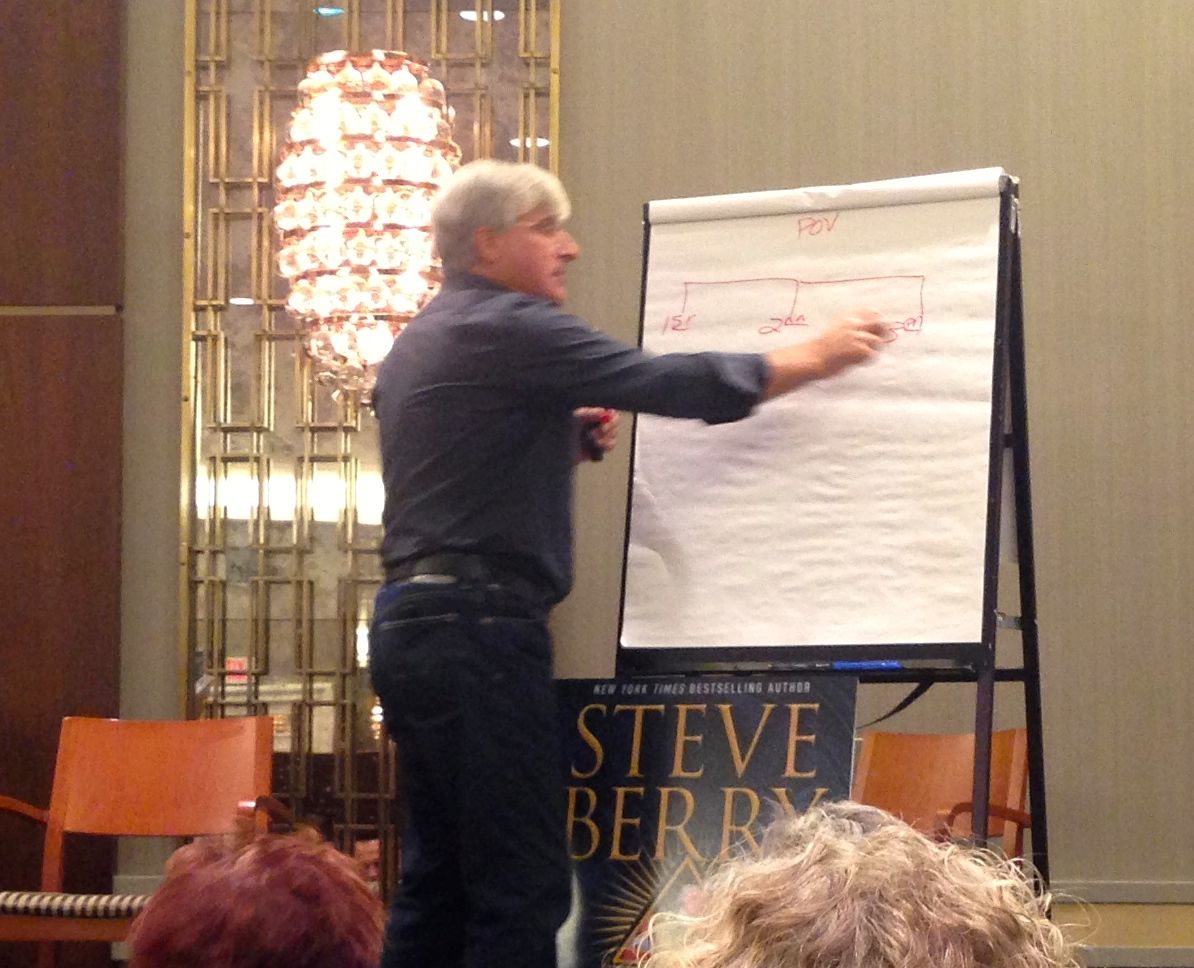
Some of the best takeaways from ThrillerFest earlier this year are sticking with me. In this class (photo below), the iconic Steve Berry does a classic lecture titled “Who’s telling the story?”. This is a great rundown of the major POV’s a story might have and how you can do your best in each. I am a big third person fan. Steve does a great job of teaching what you can do to keep yourself as tight in the skin of your character’s POV as possible. One of the biggest phrases he used was what he called ‘psychic distance’. This was the distance you have between yourself and the character you’re writing/reading. When you typically call them by name, you create a little more distance than using he/she. (This is even a little more distant than first person using ‘I’). You want to be in the eyes of the POV character who’s telling the story. That way we feel every bump, bruise and rush he/she feels. When you’re in the eyes of your character, you wouldn’t typically call them by name, it has a way of creating distance.
He talked about the times when you have several characters in a scene, and sometimes you just have to use a name. You have to keep the story straight. But as soon as possible, he reverts back to the he/she usage to get in as tight to the POV as possible.
I think about this a lot when I’m writing a scene with two women or two men (or more). But if you want to hear it from the masters mouth, ThrillerFest records and sells the CraftFest lectures. I’ve bought several of them and listen to them when I need a refresher. It’s a great way to keep it close to the vest.
I’ve included the links below to get you to the class I mentioned specifically, as well as the overall CraftFest library.
Check it out:
Who’s Telling The Story – Steve Berry
CraftFest CD Library

The Book Designer
Posted: October 1, 2014 in WritingTags: book cover design, how to market a book, joanna penn, joel friedlander, the book designer
Practical advice to help build better books…
In Joanna Penn’s How to Market a Book, I stumbled upon one of the more interesting links she provides in the body. It had to do with professional book cover design. I knew that I would be getting to this point sooner or later, knowing I’ll probably start with the e-book route, but I had no idea how good e-book covers (and most especially how bad e-book covers) look.
The link below takes you to a great site constructed by Joel Friedlander, an author and an award-winning book designer.
Among some other great content he posts, he provides a monthly e-book cover design awards section. This was a really great idea and helped me look at various forms of great work, noting who the designer was. It’s a great way to skim through a list of preferred art.
Check it out:
The Book Designer
You can also follow Joel on Twitter (amongst other media forms) @jfbookman
Scrivener – what is it?
Posted: September 30, 2014 in WritingTags: joanna penn, joseph michael, scrivener, the creative penn
Well, we know that it means ‘to scribe’, but to the uninitiated, it is really a fantastic writing tool.
I’m not going to go into details because I’m a mere novice with this program, but I will provide some excellent links for you to follow up on the best support and free webinar out there.
Scrivener is a tool created to help with writing, organizing and reordering long form text. Sound familiar? Yeah, that sounds like my novel too. Better yet, it was crafted to allow you to keep all your research together in the same app. This helps so you don’t have to open other documents or programs just to look up the one fact you buried away and want to use or that one photo you were using to help you describe a particular scene. It’s all under one hood.
This, in my mind, beats the typical word processor over the head with a great big ‘duh, why didn’t you think of that?’
I’ve only just started using it, but it’s so easy I don’t think I’ll go back to my, ahem, Microsoft program that does a few things to help me format.
But speaking of that, here’s the winning hand: Scrivener will help you format that wonderful text of yours into the formats required for all major self/indie publishing routes such as Kindle and Amazon. And if your editor, agent or publisher only has Word, then you can save it as that too.
I’m hooked, learning and using it every day. But there is always a way to learn more. One of the most prominent consultants regarding the learning of Scrivener is Joseph Michael (a Scrivener Coach). Google it and you’ll find his name anywhere a solid tutorial or how-to page is found.
Lastly, I have great news. Our super, self-help writing coach and best-selling author, Joanna Penn, is providing a free webinar Oct. 16th. I’ve included the link below. I’m attending and encourage you to attend as well. If anything, it will give you a great introduction to all the things this tool can do.
Check it out:
Scrivener homepage
Free Trial Download
Free Webinar – Oct 16th
ThrillerFest lectures
Posted: September 29, 2014 in WritingTags: joanna penn, Steve Berry, ThrillerFest
ThrillerFest registration is now open. What exactly is it? It’s about all things within the thriller genre. Most importantly is what it is not. It is not just a chance to meet your favorite author and get their autograph – and occasional selfie if they oblige. But you still get to do that. It is not just a chance to listen to a panel of famous authors talk about their books. But you still get to do that.
So what is it?
It’s about the chance to learn and grow and network.
You learn by listening to individual lectures from these authors. Steve Berry teaches a couple of classes where great nuggets of knowledge still ring in my head. He was talking about ‘the six C’s of story structure’. And his words still echo. “Where do you start your story? As close to the end as possible…”. Just brilliant.
It’s the ability to sit in a class where a handful of real FBI agents talk about some interesting cases they’ve been through. It’s getting the chance to sit down and pitch to many real NY agents for hours, until you’re actually tired of talking.
I’ve grown from the lectures I sat in. There were times I learned so much after sitting in class that I had to run up to my room and start typing.
I’ve networked with groups of other aspiring authors, as well as famous authors themselves. I was able to meet the unstoppable Joanna Penn. A legend in the field of online marketing, book writing and everything about controlling your own destiny as a writer.
This is THE conference to attend if you’re into all things ‘thriller’.
Check it out: ThrillerFest
 Joseph "Peppi" Vecchio