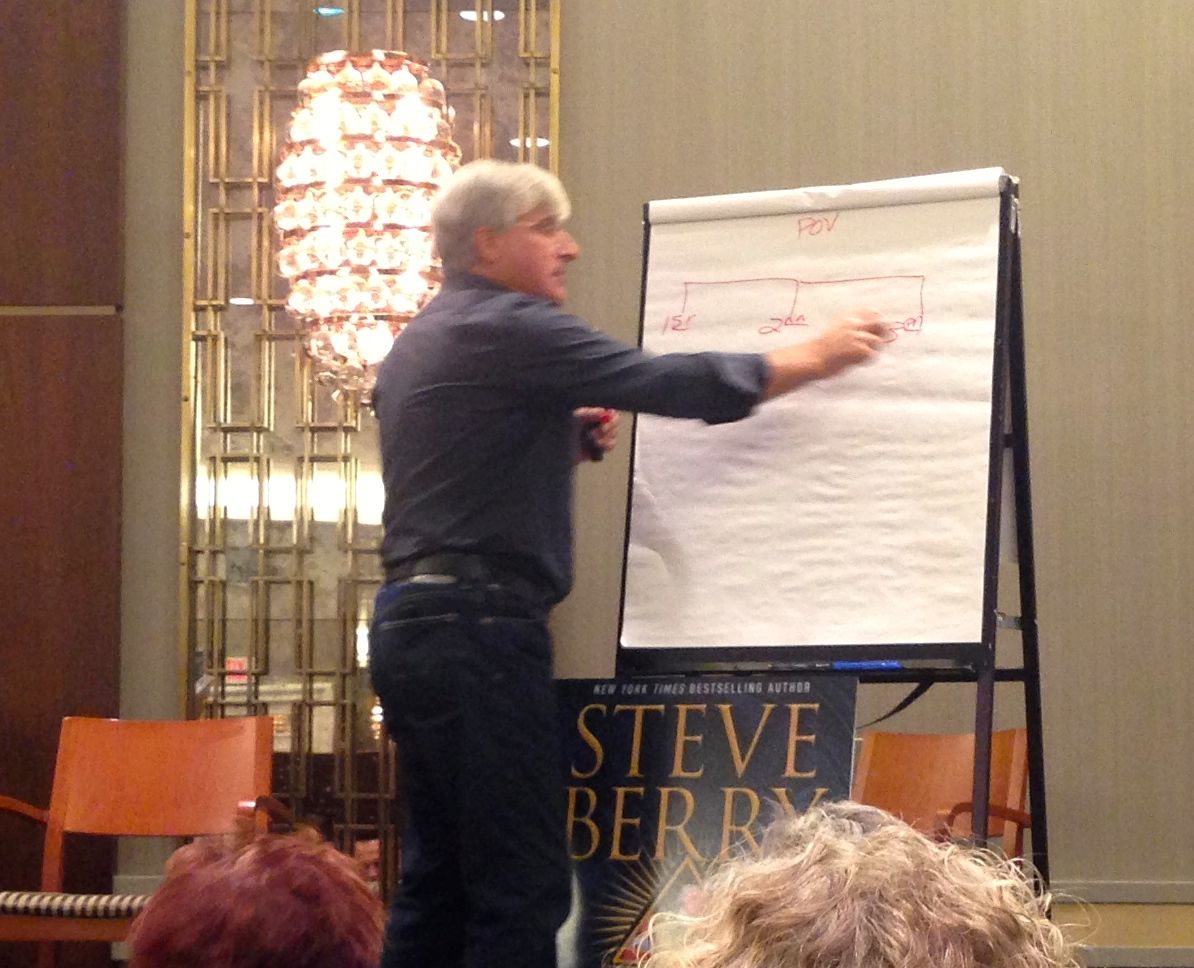
I found the link to Steve Berry’s famous lecture about story structure. In the photo below, he’s covering the POV for an earlier lecture titled Who’s Telling the Story. But the link I’m providing is to the Six C’s of Story Structure. This is where I heard the great line _ “Where do you start your story? As close to the end as possible.”
In this lecture, he also talks about the ‘crucible’. The point in your story where the main character has been put in a scene or through the paces and comes out different. Changed. In a position where he can only move forward. It’s the kind of moment where Luke Skywalker goes back to his aunt and uncle’s house only to find them all dead. There’s nothing for him to do but move forward. To take on the evil empire.
But this is certainly a great class and CD to get and listen to. Steve is entertaining, charismatic and even funny as, in his own words, “a recovering lawyer”.

Check him out:
Steve Berry – The Six C’s of Story Structure
CraftFest 2014
Steve_Berry

Steve Berry

Posted: October 2, 2014 in Writing
Tags: , ,

Some of the best takeaways from ThrillerFest earlier this year are sticking with me. In this class (photo below), the iconic Steve Berry does a classic lecture titled “Who’s telling the story?”. This is a great rundown of the major POV’s a story might have and how you can do your best in each. I am a big third person fan. Steve does a great job of teaching what you can do to keep yourself as tight in the skin of your character’s POV as possible. One of the biggest phrases he used was what he called ‘psychic distance’. This was the distance you have between yourself and the character you’re writing/reading. When you typically call them by name, you create a little more distance than using he/she. (This is even a little more distant than first person using ‘I’). You want to be in the eyes of the POV character who’s telling the story. That way we feel every bump, bruise and rush he/she feels. When you’re in the eyes of your character, you wouldn’t typically call them by name, it has a way of creating distance.

He talked about the times when you have several characters in a scene, and sometimes you just have to use a name. You have to keep the story straight. But as soon as possible, he reverts back to the he/she usage to get in as tight to the POV as possible.

I think about this a lot when I’m writing a scene with two women or two men (or more). But if you want to hear it from the masters mouth, ThrillerFest records and sells the CraftFest lectures. I’ve bought several of them and listen to them when I need a refresher. It’s a great way to keep it close to the vest.

I’ve included the links below to get you to the class I mentioned specifically, as well as the overall CraftFest library.

Check it out:
Who’s Telling The Story – Steve Berry
CraftFest CD Library

Steve_Berry

Practical advice to help build better books…

In Joanna Penn’s How to Market a Book, I stumbled upon one of the more interesting links she provides in the body. It had to do with professional book cover design. I knew that I would be getting to this point sooner or later, knowing I’ll probably start with the e-book route, but I had no idea how good e-book covers (and most especially how bad e-book covers) look.
The link below takes you to a great site constructed by Joel Friedlander, an author and an award-winning book designer.
Among some other great content he posts, he provides a monthly e-book cover design awards section. This was a really great idea and helped me look at various forms of great work, noting who the designer was. It’s a great way to skim through a list of preferred art.
Check it out:
The Book Designer

You can also follow Joel on Twitter (amongst other media forms) @jfbookman

Well, we know that it means ‘to scribe’, but to the uninitiated, it is really a fantastic writing tool.
I’m not going to go into details because I’m a mere novice with this program, but I will provide some excellent links for you to follow up on the best support and free webinar out there.

Scrivener is a tool created to help with writing, organizing and reordering long form text. Sound familiar? Yeah, that sounds like my novel too. Better yet, it was crafted to allow you to keep all your research together in the same app. This helps so you don’t have to open other documents or programs just to look up the one fact you buried away and want to use or that one photo you were using to help you describe a particular scene. It’s all under one hood.
This, in my mind, beats the typical word processor over the head with a great big ‘duh, why didn’t you think of that?’
I’ve only just started using it, but it’s so easy I don’t think I’ll go back to my, ahem, Microsoft program that does a few things to help me format.
But speaking of that, here’s the winning hand: Scrivener will help you format that wonderful text of yours into the formats required for all major self/indie publishing routes such as Kindle and Amazon. And if your editor, agent or publisher only has Word, then you can save it as that too.
I’m hooked, learning and using it every day. But there is always a way to learn more. One of the most prominent consultants regarding the learning of Scrivener is Joseph Michael (a Scrivener Coach). Google it and you’ll find his name anywhere a solid tutorial or how-to page is found.

Lastly, I have great news. Our super, self-help writing coach and best-selling author, Joanna Penn, is providing a free webinar Oct. 16th. I’ve included the link below. I’m attending and encourage you to attend as well. If anything, it will give you a great introduction to all the things this tool can do.

Check it out:

Scrivener homepage
Free Trial Download
Free Webinar – Oct 16th

ThrillerFest lectures

Posted: September 29, 2014 in Writing
Tags: , ,

ThrillerFest registration is now open. What exactly is it? It’s about all things within the thriller genre. Most importantly is what it is not. It is not just a chance to meet your favorite author and get their autograph – and occasional selfie if they oblige. But you still get to do that. It is not just a chance to listen to a panel of famous authors talk about their books. But you still get to do that.
So what is it?
It’s about the chance to learn and grow and network.
You learn by listening to individual lectures from these authors. Steve Berry teaches a couple of classes where great nuggets of knowledge still ring in my head. He was talking about ‘the six C’s of story structure’. And his words still echo. “Where do you start your story? As close to the end as possible…”. Just brilliant.
It’s the ability to sit in a class where a handful of real FBI agents talk about some interesting cases they’ve been through. It’s getting the chance to sit down and pitch to many real NY agents for hours, until you’re actually tired of talking.
I’ve grown from the lectures I sat in. There were times I learned so much after sitting in class that I had to run up to my room and start typing.
I’ve networked with groups of other aspiring authors, as well as famous authors themselves. I was able to meet the unstoppable Joanna Penn. A legend in the field of online marketing, book writing and everything about controlling your own destiny as a writer.
This is THE conference to attend if you’re into all things ‘thriller’.
Check it out: ThrillerFest

Randy Ingermanson still helps me when I least expect it. I found his website a few years ago and read some great writing tutorials concerning the ‘Snowflake Method’ and ‘Writing The Perfect Scene’. They helped me get started and solidified a foundation from which I grew. After a few years of writing every morning in the dark (before the kids get up), I felt good about writing scenes. Somehow I managed good conflict in practically every one of them and in each one I also found a way to end on a good dilemma. I patted myself on the back feeling pretty strong about myself and my writing. But eventually I knew I had to take it to another level. I revisited Randy’s site and reread the page concerning ‘Writing The Perfect Scene’. Ha. Somehow I found that all that clever writing I did could fit easily within the proposed ideas he set forth. Even though I hadn’t visited his site in a while, I apparently incorporated his philosophy into my writing and it certainly made it better.
It reminds me of an old Bruce Lee quote about simplicity: “Before I studied the art, a punch to me was just like a punch, a kick just like a kick. After I learned the art, a punch was no longer a punch, a kick no longer a kick. Now that I’ve understood the art, a punch is just like a punch, a kick just like a kick. ” At some point you start using them as tools and you’re not bound by the thought of the structure of everything you have to do to accomplish something that should be simple.
I’m hoping, with Randy’s helpful website, that a scene is just a scene and that I’m on my way to mastering the art.
Check out Randy’s page:
Writing The Perfect Scene

David Baldacci

Posted: September 23, 2014 in Writing
Tags: , ,

Peppi Vecchio
Okay. Enough already. I have to talk about the guy who really started it for me. You see I was sketching out something in the lines of a techno-thriller and struggling quite a bit. I hadn’t read a good author in who knows when, and then the exact kind of thriller genre book I needed came from a familiar source, my mom. She said to try this guy, and she handed me a paperback of David Baldacci’s First Family. I was completely sucked in within the first few pages. To date I’ve read most everything he’s written.
What he did for me was make me realize you could write with a very easy and relaxed style, not so laden with descriptions that you wear our your adjective source and still paint a vivid picture and tell a thrilling story. Besides, he made it look easy. Of course, I realized since then that it is not easy to create such wonderful pieces of work, but I endeavor to do so.
Equally impressive is his starting The Wish You Well Foundation which is focused on supporting family literacy. It’s a great cause.
We had hoped to see him at ThrillerFest in NY this past year, but he could not make it. Crossing fingers that he makes it next year.
Check him out:
David Baldacci
The Wish You Well Foundation

James_Rollins_Grant_Blackwood
I managed to find another techno-thriller writer I like, James Rollins. At ThrillerFest X I was able to sit and talk with Grant Blackwood, who co-authored The Kill Switch with James. Grant also taught one of the classes. Very interesting guy. James was not there this past year, but I’m hoping to see him there soon. Grant was kind enough to inscribe the inside of their latest book. I only just started it and can tell it’s going to be good.
Check them out:
James Rollins
Grant Blackwood

David Morrell

Posted: September 19, 2014 in Writing
Tags: , , ,

David_Morrell
ThrillerFest is an amazing conference concerning all things in the thriller genre. One of the best things they started this year was an immersive class called Master CraftFest. This is a class where you spend the entire day with about ten other budding authors and a teacher that has done more things in the genre than you can imagine.
I was lucky enough to be placed in David (creator of Rambo, played by Sylvester Stallone) Morrell’s class. Aside from a short lunch, we ground out ten hours of workshop time. In this class the instructors critique your first ten pages (you submit weeks before the class) and they’re all discussed intimately. One of my greatest takeaways was David’s picking at the ‘trombone effect’ as he calls it. It is finding those pesky, hidden past tense words like ‘had’ in your sentences. When you realize they jerk the ready in and out of present tense, you can easily picture a trombone sliding back and forth. As he tells it, you’re telling a flashback at this point. When you look back at your work and see a flashback within a flashback, you realize how ineffective the work is. It’s okay to put a flashback in your work – but as he reminded us, ‘you better have a damn good reason to do so’.
What a fantastic writing coach and mentor. He freely hands out some base writing philosophies on his website:
David on Writing

Catherine Coulter

Posted: September 18, 2014 in Writing
Tags: ,

Peppi Vecchio
Catherine Coulter has written 70 novels, with 66 of them hitting the New York Times bestsellers list. Originally known for her historical romances, she started writing suspense thrillers, and with great success. I met Catherine in an elevator at ThrillerFest 9 in New York. She stood quietly in the back, a handful of something or others clung to her chest and she had sunglasses or dark glasses on. I didn’t recognize her at first. But couldn’t help but think this chic woman was important. Then she reached out her hand and introduced herself. As she exited the elevator I couldn’t help but count through all the FBI suspense titles I’d recently seen of hers in the bookstore.
Later in the conference, I had the chance to attend one of her lectures. Before it started she went around and introduced herself to each and every attendee. Magnificent. She did everything with a smile and grace. I hadn’t previously read anything of hers, but quickly sought out Bombshell. It was excellent.
During her class, she introduced me as the man she had sex with her in the elevator earlier. Of course it was all in fun, but she has a grand sense of humor. After that, she certainly had a fan for life.
Check her out: Catherine Coulter