Archive for the ‘Writing’ Category

Free download Friday!

Posted: May 8, 2015 in Writing

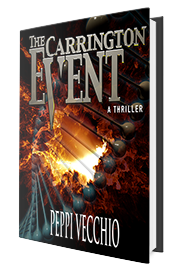
Book sales are going very well. So I thought I’d try an experiment with price elasticity. Download The Carrington Event for FREE today.

The print version has turned out to be more popular than I expected. I cannot give the print version away (damn those fixed costs). But I can run promotions on the digital version. So let’s see what happens when I give it away for FREE.

The Carrington Event

The Carrington Event

****************************************************************

What if a biologist has to team up with the wife he just cheated on to escape a deadly game of scientific espionage?

THE CARRINGTON EVENT

James Randall Parker is a synthetic biologist who has heard enough at a conference in Rome. He’s now sure that no one else has implemented artificial DNA into humans like he has. But out of the lab and out of the U.S. for the first time, he’s not prepared for the gauntlet of dynamic personalities that want to steal his work.

His world is quickly turned upside down when he’s seduced by a beautiful spy and embroiled in a deadly game of scientific espionage that he learns is driven by a secret underground society known as the Nexus.

Now Jim Parker must team up with the wife he just cheated on, a busy executive with a secret of her own, as they evade the far reaching influence of the Nexus, stomping around some of Italy’s most ancient and storied cities. But when the Nexus assassin tasked with finding and killing him discovers an oddity in his past that ties him to her own broken life, does she become an ally or motivated enemy?

The Carrington Event will take you on a thrill ride of adventure shadowed by a hidden solar catastrophe that will disrupt world order within the next 48 hours…

After we go through a round of edits, I schedule some time on the phone with my editor so we can actually talk. I really enjoy talking things through. Ideas flow faster and freer than 20 emails or 100 IM’s.

TCE_3D_transparent

So when we finished The Carrington Event, we had a little time to chat about the book industry in general. I talked about the marketing and promotions I was working on, as well as all the social media footprint exercises you must go through whether you’re a traditionally published author or Indie.

I was proud of all the ideas and devices I gathered to help sell my book.

And then she gave me one last edit.

It was an edit of my actions.

The last thing she said to me was…”Marketing is great. But don’t get so caught up in everything that you forget the main thing. You’re an author. Start writing your next book…”

Geez. I expected to hear that from the publisher. But she’s right. I need to get the momentum for writing back. You know what actually hurts after you write a good book and people buy it, read it and like it? They look for your next one. And what if it’s just a bare spot on the bookshelf? They go through the void of having to wait.

Then I reflected on my own purchasing habits. When I first picked up a Steve Berry or David Baldacci novel, I was floored. Loved it. Went back to the bookstore and bought everything they published. And now that I’ve read them all, I wait patiently for their next one. Biding my time until I hear about pre-orders and release dates. If I wasn’t so busy writing myself, I’d probably be in agony. Although I certainly would love to hook readers the way those giants do, the last thing I want is to make people wait. Especially now that my book is a series…

So if you’re a writer, get out there and start writing. Don’t give your audience a single slice of pizza. Make the whole pie available. They’ll like you more for it.

A retrospective

Posted: April 9, 2015 in Writing

In the software world, after we’ve spent a clump of time and accomplished something, we go back and do a retrospective to see what we did right and what we can do better.

TCE_3D_transparent

I thought I’d share some of my findings in hopes that it may help you in your own endeavors.

Let’s start with constructive criticism so we can end on a positive note.

Indie publishing can be quite a bit of extra effort. I chose to do the book formatting myself. There were plenty of templates and examples around and this should be easy, right?
Not so much. I didn’t build and test those formats before I started this book. I’d completed other manuscripts so I wasn’t trying desperately to complete one. I knew how to finish. I figured it’d be a simple task to format the entire document and get all my spacing and margins just right after I was done. The reality is that I spent hours retouching the body of work making everything true. Testing, checking, adding space, removing space. I purchased Scrivener about half way through this book and had the learning curve of that program on top of everything else.

What could I have done better? I should have spent more time prepping my base format and learning the specifics of the tools I’m using, both Scrivener and Word. I was ecstatic and practically gloating when I finished writing and was in a rush to get this one out. Because of that, I stumbled over simple formatting basics.

Here’s a good one****

That flippin’ hanging indent on Word. I was using Word for my iBooks/Smashwords setup. I worked closely with a template and thought everything was fine. I submitted to Smashwords and their Autovetter had caught a few things, but eventually everything went through. So I posted on iBooks (iTunes) with a soft launch. And right away I was told the right-hand margin was cutting off one or two characters on every page. What?!? But the Autovetter said everything was good. In all the previewers they have, everything looked good. How did this happen only when it was live?

I had to go back and comb through everything I did. Alas, the right indent was just outside the margin. Just enough to chop off a character or two. It was hard to spot. All of their sophisticated programs and previewers missed it. I spent a whole weekend looking for this and finally fixed and updated the doc. Yikes!

So for this next round, now that I have acceptable formats, I’m going to start writing on those so that I don’t have to climb over 88 or 90 thousand words fixing little spacing issues, tabs and indents.

The good side.

I learned a great deal about the whole end of publishing by doing this myself. I learned about book formatting – published the print version through CreateSpace (the book looks great, BTW). There’s a whole other world when it comes to formatting for print. I learned about Amazon, Smashwords, iBooks, and Nook. Now I can make things even better. Faster. I have a line of books I want to produce and now I’m off the starting block.

I found an editing service that I can’t live without. I personally use the Fiction Fix-It shop. I urge you to try several shops and editors until you find one that works for you. My editor is more than that. She’s a collaborator, a mentor and editor. I learn from her. She doesn’t just red-line my work. The notes she leaves speak clearly to me. She challenges me. She offers suggestions when things don’t look like they fit. Every dollar I’ve spent having my work polished by this multi-published author is completely worth it. Find one yourself. You’re writing will be better for it.

And for God’s sake, have someone else do your book cover. I’ve been working in Photoshop for 15 years. I’m efficient at doing most things, but it takes someone special to create something out of nothing. But how do you go down the road with a designer only to find you’re spending money and don’t like it?
That’s an easy fix. Have more designers chime in.
Doesn’t that cost more money?
Not if you use 99Designs.
For a good price, I had over 30 different designs by around 20 or so designers give me their best effort in a design contest. It spawned many great ideas. I finally found one that blew me away and took it along for the ride. I never would have done this good by myself. So please don’t yank in some clip-art and think you’re doing yourself a favor. Hire a professional. The book cover is most likely the first thing your prospective audience sees when they want to examine whether they’re interested or not.

But certainly not the past.

This is a brief touch on breaking the flow or the fun of your story with jaunts back in time.

Your story is not a sci-fi time machine and shouldn’t be treated as such.

I had this point hammered home when I spent 10 hours in a small 10 person class with the masterful writer David Morrell (the creator of Rambo, Murder as a Fine Art, and at least a dozen other best sellers).

So David takes a look at our 10 page submission, marks it up and finds a common thread we all failed. Dropping in what he called “flashbacks”. Using levers like the word “had” in the middle of a moment. This yanks the reader out of the present, flips you into the past and thoroughly disrupts the action of being “in the skin” of your POV character.

Now, it’s okay to do this, but don’t do it often and as he said, “Make sure you have a damn good reason to do it”.

I took a look at the rest of my manuscript and searched for the word “had”. Uggh. I found it too many times. In many places I was able to drop it altogether. In others I found crafty ways to import that pertinent piece of information without dropping you out of the present. It was tough to go back and fix, but completely worth it. When I watch people reading my book and continuously turning pages, I know I did the right thing.

So i urge you to go back and see if you’re constantly referring to some action in the past. Something that takes the reader out of the heart-thumping moment.

I think one of the things that makes growing as a writer so fun is that you learn to immerse yourself deeper and deeper into your POV’s. Probably much like an actor. When you’re writing and completely lost in the moment, typing so hard, sitting on the edge of your seat because you’re feeling yourself live through your POV, you’re readers will too.

So count the “had’s” and live in the present. You don’t want to make your thriller part “memoir”. 🙂

First off, what is a Mosaic? Is there really such a thing?

Certainly.

Mosaics have different cell lines within their bodies. But they’re born from the same egg.

Chimeras also have different cell lines. But they come from separate eggs.

Typically, when two eggs in the womb get fertilized by two different sperm cells, they create fraternal twins. But rarely, though it does happen, as the eggs begin their development, they fuse.

The title “Chimera” is mythical being composed of more than one animal. A human Chimera is someone with two sets of DNA. I find this fascinating because Mosaics and Chimeras live amongst us.

I read this interesting article about Mrs. “McK”. A woman in Northern England who donated blood in 1953 and it was discovered she two different types of blood. It was the first documented case of a human chimera.

Mosaics and Chimeras are all around. Sometimes they have two different color eyes. Sometimes they have different patches of skin. Mostly, the outward changes are subtle. They just have complicated DNA.

This kind of color in our own selves can be a great way to add depth to a character.

It can also make for good crime scene confusion. DNA analysis can distinguish a Mosaic’s sample from others. But a Chimera could be confused with another family member – unless the DNA is taken from the suspects blood.

But I really enjoy learning about what makes us ‘us’. Mosaicism and Chimerism are just another component of the most complicated animal on earth. The next time you need a good or bad character with two different color eyes, make them a Mosaic or Chimera. They might just get away with murder.

Make your hero lose…yet win!

Posted: March 25, 2015 in Writing

There are many ways to end your novel. But one of my ultimate favorites is when your hero loses.
But the hero can’t just lose. She has to win something. She has to defeat part of the problem. Not necessarily the entire army of bad guys. But at least something.

So how does this work?

Simple. Your hero has to have an alternate goal. Typically they’re engaged in the main goal. Defeating the bad guy, saving the world. The entire focus is on the main goal. And somehow, a secondary goal quietly slips in.
One of the best examples, and a slightly old one – sorry, is the original Rocky movie.

Rocky is all about defeating the champ. Once he accepts the challenge to fight the champ, it’s all about defeating the greatest champ. An insurmountable battle. A fight you’re sure he cannot win. If he does win outright, it stinks. It’s too easy. It cheapens the story.

So how do they get out of it?

The night before the fight, Rocky goes down to the venue. He’s looking around the whole arena and notices the color of his shorts in the 50 foot tall banner are wrong. He remarks to the promoter, who just happens to show up, and the promoter dismisses it. He states that in the end it really won’t matter. It’ll still make good entertainment.

Deep down, Rocky knows he can’t win. He heads home and confides in Adrian that he won’t be able to defeat the champ. He can’t beat Apollo Creed.

But…

But no one has ever gone the distance with Apollo.

“I just want to go the distance. No one has ever gone the distance with Apollo.” says Rocky.

And there it is. A secondary goal. A somewhat minor one compared to the main goal, but it’s there. If he wins, it’ll be a miracle. But if he doesn’t, he can at least go the distance and accomplish a personal goal. He’ll have achieved something that means something important to him. His own personal victory.

So when he really loses, but goes the distance, we feel that he’s won. He’s won his personal goal and we all cheer for the accomplishment. Even though he lost the fight.

So how can you set up some secondary, personal goal?

Think on it. I’ll be there are a million ways. And if it you find one, it’ll really thicken your story.

This is also a great way to setup a sequel.

Which isn’t a bad thing…

I’m punching this blog out on my phone, so bear with me.

As an author, indie or traditional, it’s extremely helpful to have a strong social media spine to your business plan. My first goal was to learn to write good enough to have something worthy to sell. I never intended to be on the bottom of the indie or traditional slush pile just to call myself an author. I want to write good books. Good stories.

Once I was comfortable with my work, I began navigating the social media ocean. I was never really interested in tweeting. It’s a twist on the publish/subscribe model with tiny messages. Whatever. But I knew it was important. Through my initial discovery I met many interesting and like minded authors. I’ve even purchased quite a few eBooks based solely on what I found on Twitter. Then I started to love It. Really cool.

One of the next steps was to start growing my followers list. You follow people in the same vein, post good messages and hopefully people will follow you. Sometimes it was just a numbers game. Click, click, click. Type something, anything, and watch your numbers grow. It gets silly at this point. So many times you follow or tweet without caring. The followers list was all that mattered. That’s when I hate Twitter. I hate when it’s just a game.

But something changed. I’ve been busy with the final edits of my book, training for American Ninja Warrior, and everything in between without getting time to blog. I cringe at this because I know it slows my site traffic. Nonetheless, I checked my traffic to see how bad it was.

I was shocked.

Traffic was good. Many new blog followers. How? Why?

Twitter.

Twitter followers were kind enough to visit. Kind enough to peruse my content. Kind enough to follow. I was back to loving Twitter again.

I love to learn. Or re-learn. Or remember things I’ve learned in the past. Last night I was watching “Brain Games” on NatGeo and they talked about how people find each other attractive. They brought up the Golden Ratio and how our perceptions of attractiveness could possibly be based on how well our faces reflect it.

First off, what is the Golden Ratio?

Second, what does this have to do with writing?

Per the definition I found on Wikipedia: “In mathematics, two quantities are in the golden ratio if their ratio is the same as the ratio of their sum to the larger of the two quantities.” In matters of the face, this boils down to how your face is proportioned. A quick study shows that typically our faces should be half as wide as they are tall. But there are many other proportions that pertain to the Golden Ratio. It’s really quite intriguing if you look it up.

So how does this affect my writing?

Well, when I write and read, I enjoy learning along the way. It’s not enough that the geeky scientist finds another co-worker attractive and out of his level. How will they hook up? Suddenly, they’re trapped under a desk while explosions rock the building. Terrorists are fighting to steal some secret biological weapon found in their facility. He finally professes his attraction to her and tells her she’s a perfect 1.618 (the Golden Ratio). What? We all say, “huh?”. Then he explains the Golden Ratio and not just how it pertains to the face, but to many other things. Great artists of our time have known it and use it in their paintings and sculptures. It means something other than “I think you’re cute”. Bleah. (I hope I never write that in one of my books).

It becomes another and interesting vehicle about something so normal in life. It adds depth. It adds fun. It adds something we learn along the way. And now, not only are we happy the two are together, but we have a “takeaway” from our book that we’ll think about as soon as we get out from under our covers, coveting that eBook on our iPad or Kindle and strut around the real world.

This is exactly why I enjoy writing techno-thrillers and pepper them with science. Our world and how we perceive it is amazing…and endless.

The New Year Resolutionists – Uggh

Posted: January 10, 2015 in Writing

I’m quite a fitness fanatic. I love playing sports and I love training to play my sports better. It’s just flat out fun. (will be posting my American Ninja Warrior submission tape soon…)

So every time I go to the gym in January and February, I find it filled with new faces. The faces of this year’s crop of New Year’s Resolutionists. The gym is usually a little more packed than usual and you have to maneuver between people re-learning what to do.

Now don’t get me wrong. I think it’s great to see people getting back in shape. I always think good of them. What frustrates me is watching them fall off over the next few weeks or months. By spring, I pretty much see the same old faces. The same group of people that endure the cold, the heat, the early, early mornings.

And in all reality, I really do wish more of the New Year Resolutionists would stay. To see newcomers add to the energy in the room. To see that they really do care about their health.

Yes. You knew this was coming around to writing sooner or later. New Year’s Resolutionists could pertain to writers too. To see all the people sitting down at their laptops – this is going to be the year I write that book! Or finish that project. Or something in the writing vein. If we didn’t have new writers, the train would slow down. We wouldn’t be pushing the genre to new heights. How many times do you sit down and watch a movie on TV and wonder, when are they going to come up with something new?

Well, it’s not up to someone else. It’s up to you. Or us. Or whoever wakes up in the morning and wants to do something new. To the person who just can’t stand walking by the book aisle in the supermarket because they know their book isn’t there – yet. Because they haven’t finished the book they’ve been chewing on for the last few years.

Don’t be a short-lived resolutionist. Be a dedicated writer, willing to challenge your own fears and weaknesses and create something that’s never been done before.

How do you keep up with your genre?
These days it’s impossible to read everyone’s website, blog or tweet.
For me, I have a couple of go-to’s that keep me in the loop. One of my favorites is The Big Thrill newsletter/magazine.
There are great interviews with some of the most successful authors in my genre – Thrillers. As well, there are many great interviews with authors about their latest releases.
In this month’s edition, my friend Joanna Penn (you probably know her as JF Penn or The Creative Penn) does a nice article and introspective with author Scott Mariani.
It’s tightly coupled with my favorite writers conference ThrillerFest, so you’ll see headline ads for it throughout, but I consider these two venues the main vein of thriller writing help and support.
Happy New Year!